1. iptables가 제공하는 보호

 *iptables

 iptables 방화벽은 넷필터 프로젝트(Netfilter Project, http://www.netfilter.org)에서 개발됐으며, 2001년 1월의 리눅스 2.4 커널 배포 시점부터 리눅스의 일부분으로 제공됐다.

 iptables와 넷필터라는 단어 간의 차이는 리눅스 커뮤니티에서 다소 혼란의 원인이었다. 리눅스가 제공하는 모든 종류의 패킷 필터링과 맹글링(mangling) 도구의 공식적인 프로젝트명이 넷필터다. 하지만 이 단어는 네트워킹 스택으로 함수를 후킹(hooking)하는 데 사용할 수 있는 리눅스 커널 내부의 프레임워크를 말하기도 한다. 한편 iptables는 패킷에 대한 연산(필터링 등)을 수행하게 설계된 함수를 네트워킹 스택으로 후킹하기 위해 넷필터 프레임워크를 사용한다. 넷필터는 iptables가 방화벽 기능을 구현할 수 있게 프레임워크를 제공한다고 생각할 수 있다.

 넷필터가 트래픽 자체를 필터링하지는 않는다. 넷필터는 커널 내부의 적절한 부분에 후킹되게 트래픽을 필터링할 수 있는 기능을 가능케 해줄 뿐이다. 넷필터 프로젝트는 연결 추적이나 기록(logging)과 같은 커널 인프라스트럭처의 일부를 제공하기도 한다. 모든 iptables 정책은 특화된 패킷 처리를 수행하기 위해 이런 넷필터의 기능을 사용할 수 있다.

  * iptables를 이용한 패킷 필터링

 사용자는 iptables 방화벽을 이용해서 리눅스 시스템과 연동하는 IP 패킷에 대해 강력한 제어 기능을 갖출 수 있다. 이러한 제어는 리눅스 커널 내부에 구현된다.

 iptables 정책은 정렬된 규칙집합으로부터 생성된다. 규칙은 특정 분류의 패킷에 대해 취해야 할 조치를 커널에게 알려준다. 하나의 iptables 규칙은 테이블 내에 있는 하나의 체인에 적용된다. iptables 체인은 순서대로 공통적인 특징(예를 들어 리눅스 시스템으로 라우팅되거나 리눅스 시스템에서 외부로 나가는 것)을 공유하는 패킷들과 비교되는 규칙 모음이다.

 – 테이블
 테이블(table)은 패킷 필터링이나 네트워크 주소 변환(NAT, Network Address Translation)과 같은 기능의 광범위한 범주를 기술하는 iptables 구성소다. filter, nat, magle, raw 와 같은 4개의 테이블이 있다. 필터링 규칙은 filter 테이블에 적용된다. NAT 규칙은 nat 테이블에 적용되며, 패킷 데이터를 변경하는 특수 규칙은 mangle 테이블에 적용된다. 끝으로 텟필터의 연결추적 하위시스템과 독립적으로 기능해야 하는 규칙은 raw 테이블에 적용된다.

 – 체인
 각 테이블은 자신만의 고유(build-in) 체인(chain) 집합을 가지지만 사용자는 INPUT_ESTABLISHED 나 DMZ_NETWORK 와 같은 공통 태그와 관련된 규칙집합을 만들기 위해 사용자 정의 체인을 생성할 수 있다. 패킷 필터링에서 가장 중요한 고유 체인은 filter 테이블의 INPUT, OUTPUT, FORWARD 체인이다.

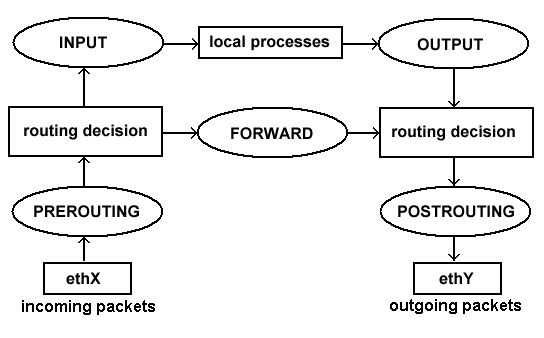
 — INPUT 체인은 커널 내부에서 라우팅 계산을 마친 후 로컬 리눅스 시스템이 목적지인 패킷(즉, 로컬 소켓이 목적지인 패킷)에 적용된다.

 — OUTPUT 체인은 리눅스 시스템 자체가 생성하는 패킷을 위해 예약된 것이다.

 — FORWARD 체인은 리눅스 시스템을 통과하는 패킷을 관리한다.(즉, 한 네트워크를 다른 네트워크와 연결하기 위해 iptables 방화벽을 사용해서 두 네트워크 간의 패킷이 방화벽을 통과해야 하는 경우)

 좀 더 견고한 iptables 설치를 위해 필요한 두 개의 추가 체인으로 nat 테이블의 PREROUTING과 POSTROUTING 체인이 있다. 이 체인은 커널 내부에서 IP 라우팅 계산을 수행하기 전과 휴에 패킷 헤더를 수정하기 위해 사용한다.
User image

iptables 패킷 흐름

 – 매치
 모든 iptables 규틱은 타겟(target)과 함께 규칙을 따르는 패킷을 어떻게 처리할지 iptables에게 알려주는 매치(Match)들을 가진다. iptables 매치는 iptables가 규칙 타겟에 의해 명시되는 동작에 따라 패킷을 처리하기 위해서 패킷이 만족해야 하는 조건이다. 예를 들어 규칙을 TCP 패킷에만 적용하고자 한다면 –protocol 매치를 사용하면 된다.

 각 매치는 iptables 명령 행에서 명시된다.

 –source (-s) : 출발지 IP 주소나 네트워크와의 매칭
 –destination (-d) : 목적지 IP 주소나 네트워크와의 매칭
 –protocol (-p) : 특정 프로토콜 값과의 매칭
 –in-interface (-i) : 입력 인터페이스(예를 들어 eth0)
 –out-interface (-o) : 출력 인터페이스
 –state : 연경 살태와의 매칭
 –string : 애플리케이션 계층 데이터 바이트 순서와의 매칭
 –comment : 커널 메모리 내의 규칙가 연계되는 최대 256 바이트의 주석

 – 타겟
 iptables 는 패킷이 규칙과 일치할 때 동작을 취하는 타겟(Target)을 지원한다.
 ACCEPT : 패킷이 본래 라우팅대로 진행된다.
 DROP : 패킷을 버린다. 더 이상 어떤 처리도 수행되지 않으며 수신 스택이 관련된 데에 한해서는 패킷이 전송된 적도 없는 것과 같다.
 LOG : 패킷을 syslog에 기록한다.
 REJECT : 패킷을 버리고 이와 동시에 적절한 응답 패킷(예를 들어 TCP 연결의 경우 TCP 재설정[Reset] 패킷, UDP 패킷의 경우 ICMP 포트 도달 불가[Port Unreachable] 메시지)을 전송한다.
 RETRUN : 호출 체인 내에서 패킷 처리를 계속한다.

 * 기본 iptables 정책

 – 정책 요구사항
 몇 개의 클라이언트와 두 개의 서버로 구성된 네트워크를 위한 효과적인 방화벽 설정에 필요한 요구사항을 정의해보자. 서버(웹서버와 DNS서버)는 외부 네트워크에서 접근할 수 있어야 한다. 내부 네트워크에 있는 시스템은 방화벽을 통해 외부 서버로 다음과 같은 유형의 트래픽을 시작할 수 있어야 한다.

 — 도메인 네임 시스템(DNS, Domain Name System) 질의

 — 파일 전송 프로토콜(FTP, File Transfer Protocol) 전송

 — 네트워크 시간 프로토콜(NTP, Network Time Protocol) 질의

 — 시큐어 쉘(SSH, Secure SHell) 세션

 — 단순 메일 전송 프로토콜(SMTP, Simple Mail Transfer Protocol) 세션

 — whois 질의

 위에 나열한 서비스 외에는 어떤 트래픽도 허용하지 않아야 한다. 내부 네트워크나 방화벽에서 바로 시작된 세션은 iptables가 상태유지형으로 추적해야 한다(유효한 상태를 따르지 않는 패킷은 기록한 후 최대한 빨리 버려야 한다). 또 NAT 서비스도 제공해야 한다.

 이와 더불어 방화벽은 외부 IP 주소로 포워딩되는 내부 네트워크로부터의 스푸팅된 패킷에 대한 제어를 구현해야 한다.

 — 방화벽 자체는 네트워크로부터 SSH를 통해 접속할 수 있어야 한다. 그러나 인증을 위해 fwknop를 실행하고 있지 않는 한 그 밖에 어떤 곳에서도 접속할 수 없어야 한다.

 — 방화벽은 내부와 외부 네트워크 모두로부터 ICMP 에코 요청(Echo Request)을 수용해야 한다. 그러나 에코 요청을 제외하면 어떤 출발지 IP 주소로부터의 원하지 않은(unsolicited) ICMP 패킷도 모두 버려야 한다.

 — 끝으로 잘못 전달된 패킷, 포트 스캔, 명시적으로 혀용된 것이 아닌 기타 연결 시도를 모두 기록하고 버리기 위해 방화벽은 기볼 기록 후 버리기 전략(log and drop stance)으로 설정해야 한다.

 – iptables.sh 스크립트 프리앰블(Preamble)

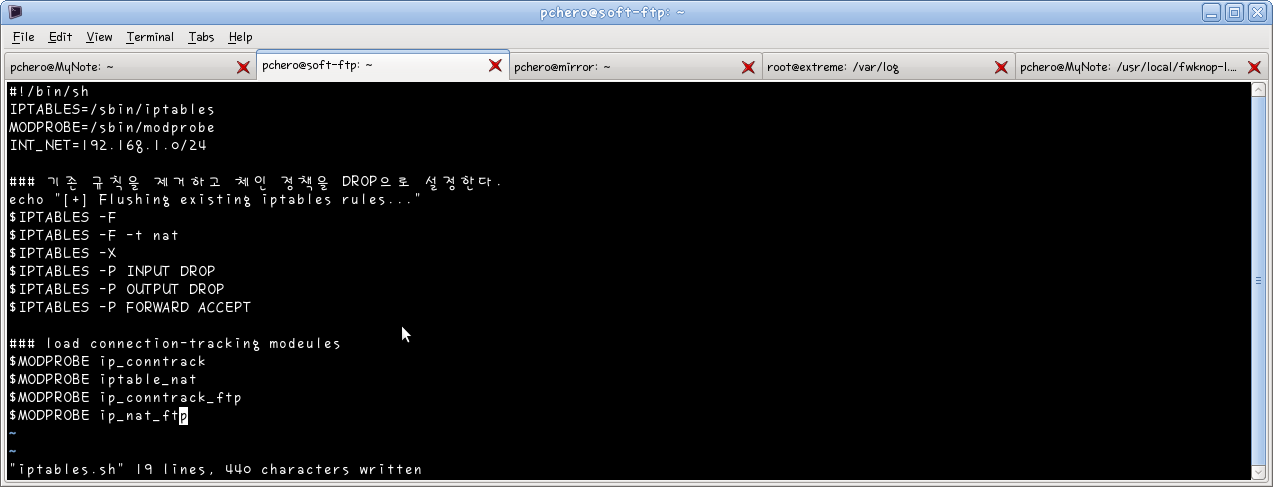
 iptables.sh 스크립트를 시작하기 위해 IPTABLES와 MODPROBE(iptables 와 modprobe 바이너리의 경로), INT_NET(내부 서브넷 주소와 마스크)과 같이 세 개의 변수를 정의하면 좋다. 이 변수들은 스크립트 전반에 걸쳐 사용된다.

 먼저 기존의 iptables 규칙이 실행 중인 커널에서 제거되고 INPUT, OUTPUT, FORWARD 에 대한 필터링 정책이 DROP 으로 설정된다. 또 modprobe 명령어를 사용해서 연결추적 모듈을 로딩한다.
User image

 – ip_conntrack : iptables에서 현재 테이블에 등록된 IP의 연결을 추적하기 위한 모듈
 – ip_conntrack_ftp, ip_nat_ftp : iptables 에서 ftp 사용을 가능하게 하는 모듈. NAT 설정을 사용하지 않는다면 ip_nat_ftp 모듈을 적재하지 않아도 된다.
 -> FTP의 경우 서버와 클라이언트 모두가 방화벽 안에 있으면 접속은 되지만, 파일 목록이나 내용 전송.. 등등이 안되는 현상이 벌어진다. 위의 적재된 모듈들은 이것을 피하기 위한 모듈이다.

 – INPUT 체인
 INPUT 체인은 로컬 시스템을 목적으로 하는 (즉, 커널의 라우팅 계산 결과 패킷이 로컬 IP 주소를 목적지로 한다는 것을 안 후) 패킷이 로컬 소켓과 통신할 수 있는지 여부를 결정하는 iptables 구성소다. INPUT 체인의 첫 번째 규칙이 iptables로 하여금 모든 패킷을 버리게 하는 것이라면(또는 INPUT 체인의 정책 설정이 DROP으로 설정돼 있다면) 시스템과 IP 통신(TCP, UDP, ICMP 등)을 통해 직접 통신하려는 모든 시도는 실패하게 된다. 주소 결정 프로토콜(ARP, Address Resolution Protocol) 역시 이더넷 네트워크상 어디에나 존재하는 중요한 트래픽이다. 그러나 ARP는 네트워크 계층이 아니라 데이터 링크 계층에서 동작하며, iptables는 IP 트래픽과 상위 프로토콜만 필터링하기 때문에 ARP 트래픽은 필터링할 수 없다.

 그러므로 ARP 요청과 응답은 iptables 정책과 무관하게 전송되고 수신된다(arptables를 이용해서 ARP 트래픽을 필터링할 수도 있다).

 – iptables 는 커널이 MAC 주소 확장을 활성화한 상태로 컴파일된 경우에만 데이터 링크 계층의 MAC 주소에 기반해서 IP 패킷을 필터링할 수 있다. 2.4 커널 시리즈에서는 사용자가 직접 MAC 주소 확장을 활성화해야 하지만 2.6 커널 시리즈에서는 기본적으로 활성화돼 있다.

 프리앰블을 완성한 후 iptables 쉘 스크립트 개발을 계속하기 위해 다음의 명령어를 사용해 INPUT 체인을 설정한다.

##### INPUT 체인 #####
echo “[+] Setting up INPUT chain…”

### 상태 추적 규칙
$IPTABLES -A INPUT -m state –state INVALID -j LOG –log-prefix “DROP INVALID ” –log-ip-options –log-tcp-options
$IPTABLES -A INPUT -m state –state INVALID -j DROP
$IPTABLES -A INPUT -m state –state ESTABLISHED,RELATED -j ACCEPT

### 안티 스푸핑 규칙
$IPTABLES -A INPUT -i eth2 -s ! $INT_NET -j LOG –log-prefix “SPOOFED PKT “
$IPTABLES -A INPUT -i eth2 -s ! $INT_NET -j DROP
### ACCEPT 규칙
#ftp
$IPTABLES -A INPUT -p tcp –dport 20 –syn -m state –state NEW -j ACCEPT
$IPTABLES -A INPUT -p tcp –dport 21 –syn -m state –state NEW -j ACCEPT
#ssh
$IPTABLES -A INPUT -p tcp –dport 22 –syn -m state –state NEW -j ACCEPT
#whois
$IPTABLES -A INPUT -p tcp –dport 43 –syn -m state –state NEW -j ACCEPT
#domain
$IPTABLES -A INPUT -p tcp –dport 53 –syn -m state –state NEW -j ACCEPT
$IPTABLES -A INPUT -p udp –dport 53 -m state –state NEW -j ACCEPT
#http
$IPTABLES -A INPUT -p tcp –dport 80 –syn -m state –state NEW -j ACCEPT
$IPTABLES -A INPUT -p udp –dport 80 -m state –state NEW -j ACCEPT
#https
$IPTABLES -A INPUT -p tcp –dport 443 –syn -m state –state NEW -j ACCEPT
#rsync
$IPTABLES -A INPUT -p tcp –dport 873 –syn -m state –state NEW -j ACCEPT
$IPTABLES -A INPUT -p udp –dport 873 -m state –state NEW -j ACCEPT
#icmp
$IPTABLES -A INPUT -p icmp –icmp-type echo-request -j ACCEPT

### 기본 INPUT LOG 규칙
$IPTABLES -A INPUT -i ! lo -j LOG –log-prefix “DROP ” –log-ip-options –log-tcp-options

 앞서 정의한 방화벽 정책 요구사항에 따르면 iptables 는 연결을 상태유지형으로 추적해야 한다. 즉, 유효한 상태와 일치하지 않는 패킷은 조기에 기록하고 버려야 한다. 이는 “### 상태 추적 규칙 주석” 밑의 3개의 iptables 명령어가 수행한다. OUTPUT과 FORWARD 체인에 대해서도 이와 유사한 세 개의 명령어를 볼 수 있다. 이런 각 규칙은 INVALID, ESTABLISHED, RELATED 기준과 함께 상태 매칭을 이용한다.

 INVALID 상태는 현존하는 어떤 연결에도 속했다고 식별할 수 없는 패킷에 적용된다. 예를 들어 느닷없이 도착한 TCP FIN 패킷(즉, 어떤 TCP 세션의 일부도 아닌 TCP FIN  패킷)은 INVALID 상태와 일치된다. ESTABLISHED 상태는 넷필터 연결 추적 하위시스템이 양방향 모두에서 패킷(예를 들어 데이터가 교환되는 TCP 연결의 승인[acknowledgement] 패킷)을 본 후에만 패킷에 대해 활성화된다. RELATED 상태는 넷필터 연결추적 하위시스템에서 새로운 연결을 시작하고 있는(그러나 이 연결이 이미 존재하는 연결과 연결돼 있는) 패킷(예를 들어 어떤 서버도 바인딩되지 않은 UDP 소켓에 패킷이 전소오딘 후 반환된 ICMP 포트 도달 불가 메시지)을 기술한다.

 다음으로 안티스푸핑 규칙을 추가했으므로 내부 네트워크에서 시작된 패킷은 반드시 192.168.1.0/24 서브넷에 속하는 출발지 주소를 가진다.

 또한 “### ACCEPT 규칙” 에는 서비스를 제공 하는 일련의 포트번호의 ACCEPT 규칙이 나와 있다. SSH 연결을 수용하는 규칙은 iptables의 –syn 명령 행 인자와 함께 NEW 상태가 일치될 때(연결추적 하위 시스템이 관련된 데 한해서 패킷이 새로운 연결을 시작하고 있음을 의미한다)만 이 규칙이 일치된다.

 끝에는 기본 LOG 규칙이 나와 있다. 스크립트 프리앰블에서 봤듯이 INPUT 체인 내의 규칙에 의해 혀용되지 않는 패킷은 이 체인에 할당된 DROP 정책에 의해 버려진다는 사실을 상기하자. 이는 OUTPUT 과 FORWARD 체인에 할당된 DROP 정책에도 적용된다. 위에서 알 수 있듯이 INPUT 체인의 설정은 특정 포트로의 접속만 수용하고 원치 않는 패킷은 기록하고 버리면 되기 때문에 매우 쉽다.

 – iptables.sh 스크립트에 대해 한 가지 주의해야 할 것은 모든 LOG 규칙이 –log-ip-options 와 –log-tcp-options 를 명령행 인자로 사용한다는 점이다. 이 인자를 통해 iptables syslog 메시지는 LOG 규칙과 일치하는 패킷이 IP 와 TCP 헤더에 IP 와 TCP 옵션을 포함하는 경우 이를 포함하게 된다. 이 기능은 psad 가 수행하는 공격 탐지와 수동적 OS 핑거프린팅의 동작 모두에 중요하다.

 – OUTPUT 체인
 OUTPUT 체인은 iptables가 로컬 시스템에 의해 생성되 네트워크 패킷에 커널 수준의 제어를 할 수 있게 해준다. 예를 들어 로컬 사용자가 외부 시스템으로 SSH 세션을 초기화하면 OUTPUT 체인을 이용해서 아웃 바운드 SYN 패킷을 허용하거나 거부할 수 있다.

 iptables.sh 에서 OUTPUT 체인 규칙 집합을 구성하는 명령어는 아래와 같다.

###### OUTPUT 체인 ######
echo “[+] Setting up OUTPUT chain…”

### 상태 추적 규칙
$IPTABLES -A OUTPUT -m state –state INVALID -j LOG –log-prefix “DROP INVALID ” –log-ip-options –log-tcp-options –log-tcp-sequence
$IPTABLES -A OUTPUT -m state –state INVALID -j DROP
$IPTABLES -A OUTPUT -m state –state ESTABLISHED,RELATED -j ACCEPT

### 외부로 나가는 연결을 허용하기 위한 ACCEPT 규칙
#ftp
$IPTABLES -A OUTPUT -p tcp –dport 20 –syn -m state –state NEW -j ACCEPT
$IPTABLES -A OUTPUT -p tcp –dport 21 –syn -m state –state NEW -j ACCEPT
#ssh
$IPTABLES -A OUTPUT -p tcp –dport 22 –syn -m state –state NEW -j ACCEPT
#whois
$IPTABLES -A OUTPUT -p tcp –dport 43 –syn -m state –state NEW -j ACCEPT
#domain
$IPTABLES -A OUTPUT -p tcp –dport 53 –syn -m state –state NEW -j ACCEPT
$IPTABLES -A OUTPUT -p udp –dport 53 -m state –state NEW -j ACCEPT
#http
$IPTABLES -A OUTPUT -p tcp –dport 80 –syn -m state –state NEW -j ACCEPT
$IPTABLES -A OUTPUT -p udp –dport 80 -m state –state NEW -j ACCEPT
#https
$IPTABLES -A OUTPUT -p tcp –dport 443 –syn -m state –state NEW -j ACCEPT
#rsync
$IPTABLES -A OUTPUT -p tcp –dport 873 –syn -m state –state NEW -j ACCEPT
$IPTABLES -A OUTPUT -p udp –dport 873 -m state –state NEW -j ACCEPT
$IPTABLES -A OUTPUT -p icmp –icmp-type echo-request -j ACCEPT

### 기본 OUTPUT LOG 규칙
$IPTABLES -A OUTPUT -o ! lo -j LOG –log-prefix “DROP ” –log-ip-options –log-tcp-options –log-tcp-sequence

 – FORWARD 체인
 FORWARD 체인은 시스템을 통해 라우팅을 시도하는 패킷과 관련된 iptables 규칙을 담당한다. filter 테이블의 iptables FORWARD 체인은 방화벽 인터페이스를 통해 포워딩되는 패킷에 대한 접근 제어 기능을 제공한다.

##### FORWARD 체인 #####
echo “[+] Setting up FORWARD chain…”

### 상태 추적 규칙
$IPTABLES -A FORWARD -m state –state INVALID -j LOG –log-prefix “DROP IINVALID ” –log-ip-options –log-tcp-options
$IPTABLES -A FORWARD -m state –state INVALID -j DROP
$IPTABLES -A FORWARD -m state –state ESTABLISHED,RELATED -j ACCEPT

### 안티 스푸핑 규칙
$IPTABLES -A FORWARD -i eth2 -s ! $INT_NET -j LOG –log-prefix “SPOOFED PKT “
$IPTABLES -A FORWARD -i eth2 -s ! $INT_NET -j DROP

### ACCEPT 규칙
# 기본적으로 FORWARD 에 한해서는 모든 포트에 ACCEPT를 적용한다.

### 기본 LOG 규칙
$IPTABLES -A FORWARD -i ! lo -j LOG –log-prefix “DROP ” –log-ip-options –log-tcp-options

 – 네트워크 주소 변환 (NAT, Network Address Translation)
 iptables 정책을 구성하는 마지막 단계는 라우팅 불가능 내부 주소 192.168.1.0/24 를 라우팅 가능한 외부 210.125.X.X 주소로 변환할 수 있게 하는 것이다. 이는 외부 클라이언트에서 시작된 웹서버나 DNS서버로의 인바운드 연결과 내부 네트워크의 시스템에서 시작된 아웃바운드 연결 모두에 적용된다. 내부 시스템에서 시작한 연결의 경우에는 출발지 NAT(SNAT, Source NAT) 타겟을 사용하며 외부 시스템에서 시작한 연결의 경우에는 목적지 NAT(DNAT, Destination NAT) 타겟을 사용한다.

 iptables nat 테이블을 모든 종류의 NAT 규칙을 위한 것으로 PREROUTING 과 POSTROUTING 이라는 두 체인을 포함한다. PREROUTING 체인은 패킷이 어느 인터페이스를 통해 전송될지 경정하기 위해 아직 커널의 라우팅 알고리즘을 통과하지 않은 패킷에 nat 테이블의 규칙을 적용하는 데 사용한다. 이 체인에서 처리되는 패킷은 아직 filter 테이블의 INPUT 이나 OUTPUT 체인과도 비교되지 않은 것이다.

 POSTROUTING 체인은 패킷이 커널의 라우팅 알고리즘을 통과한 후 계산된 물리적 인터페이스를 통해 전송되려는 시점에서 패킷 처리를 담당한다. 이 체인이 처리하는 패킷은 filter 테이블의 OUTPUT 이나 FORWARD 체인의 요구사항(mangle 테이블과 같이 등록됐을 수 있는 다른 테이블이 강제하는 요구사항도 포함)을 통과한 것이다.

##### NAT 규칙 #####
echo “[+] Setting up NAT rules…”
$IPTABLES -t nat -A POSTROUTING -s $INT_NET -o eth3 -j MASQUERADE

 POSTROUTING 규칙은 내부의 라우팅 불가능 네트워크에서 시작되며, 외부 인터넷을 목적지로 하는 연결이 IP 주소 210.125.

 iptables 정책을 작성하는 최종 단계는 리눅스 커널의 IP 포워딩을 활성화하는 것이다.

##### 포워딩 #####
echo “[+] Enabling IP forwarding
echo 1 > /proc/sys/net/ipv4/ip_forward

 – 정책 활성화
 iptables의 최고 장점 중 하나는 iptables 명령어 실행을 통해 커널 내부에서 정책을 활성화하기가 매우 쉽다는 것이다. 무거운 사용자 인터페이스나 바이너리 파일 형식 또는 비대한 관리 프로토콜은 전혀 없다.

 – iptables-save 와 iptables-restore
 iptables.sh 스크립트의 모든 iptables 명령어는 새로운 규칙을 시작하거나 체인의 기본 정책을 설정하거나 이전 규칙을 제거하기 위해 한 번에 하나씩 실행된다. 각 명령어는 iptables 정책을 생성하기 위해 매번 별도의 iptables 사용자 바이너리 실행을 필요로 한다. 그러므로 이는 시스템 부팅 시에 정책을 빠르게 적용하는 최적의 방법은 아니다. 특히 iptables 규칙의 수가 수백 개에 이르면 이런 식으로 정책을 적용하는 것은 좋지 않다. iptables 프로그램과 동일한 디렉토리에 설치되는 iptables-save 와 iptables-restore 명령어에서 훨씬 더 빠른 방법을 제공한다. iptables-save 명령어는 실행 중인 정책의 모든 iptables 규칙을 사람이 읽을 수 있는 형태로 저장하는 파일을 생성한다. 이 형식은 iptables-restore 프로그램으로 해석(interpret)할 수 있다. iptables-restore 프로그램은 ipt.save 파일에 나열된 규칙을 실행 중인 커널 내부에서 활성화한다. iptable-restore 프로그램을 한 번만 실행하면 전체 iptables 정책을 커널에 재생성할 수 있으며, iptables 프로그램을 여러 번 실행하는 것은 필요치 않다. 그러므로 iptables-save 와 iptables-restore 명령어는 iptables 규칙집합을 빠르게 적용하는 데 이상적이며, 다음과 같은 두 명령어로 나타낼 수 있다.

root@extreme:~# iptables-save > ipt.save
root@extreme:~# cat ipt.save > iptables-restore

 ipt.save 파일의 내용은 iptables 테이블에 의해 구성되며, 각 테이블을 위한 부분은 다시 iptables 체인에 의해 구성된다. 별표(*)와 테이블명(예를 들어 filter)으로 시작하는 행은 ipt.save 파일에서 특정 테이블을 위한 부분의 시작을 나타낸다. 이런 행 다음에는 해당 테이블에 속한 체인을 위한 패킷과 바이트 수를 추적하는 행이 나온다.

 ipt.save 파일의 다음 부분에는 체인에 의해 구성된 모든 iptables 규칙의 완전한 기술이 나온다. iptables-restore 는 이 부분을 이용해서 실제 iptables 규칙집합을 재생성한다(iptables-save 에 -c 옵션을 사용한 경우 규칙에 대한 패킷과 바이트 수 까지 포함해서 재생성한다).

 끝으로 COMMIT을 이용해서 ipt.save 파일의 iptables 테이블 기술 부분을 끝낸다. 이 행은 해당 테이블과 관련된 모든 정보에 대한 종료 표시자다.

 다음은 ipt.save 파일의 일부분이다.

# Generated by iptables-save v1.4.1.1 on Sat Sep 26 13:17:35 2009
*filter
:INPUT DROP [226586:80181793]
:FORWARD ACCEPT [0:0]
:OUTPUT DROP [9881:717618]
:FWSNORT_FORWARD – [0:0]
:FWSNORT_FORWARD_ESTAB – [0:0]
:FWSNORT_INPUT – [0:0]
:FWSNORT_INPUT_ESTAB – [0:0]
:FWSNORT_OUTPUT – [0:0]
:FWSNORT_OUTPUT_ESTAB – [0:0]
-A INPUT -i ! lo -j FWSNORT_INPUT
-A INPUT -p udp -m udp –dport 80 -m string –string “/etc/shadow” –algo bm –to 65535 -j LOG –log-prefix “ETC_SHADOW “
-A INPUT -p tcp -m tcp –dport 80 -m state –state ESTABLISHED -m string –string “/etc/shadow” –algo bm –to 65535 -j LOG –log-prefix “ETC_SHADOW “
-A INPUT -m state –state INVALID -j LOG –log-prefix “DROP INVALID ” –log-tcp-options –log-ip-options
-A INPUT -m state –state INVALID -j DROP
-A INPUT -m state –state RELATED,ESTABLISHED -j ACCEPT
-A INPUT -i eth0 -p tcp -m tcp –dport 20 –tcp-flags FIN,SYN,RST,ACK SYN -m state –state NEW -j ACCEPT
-A INPUT -i eth0 -p tcp -m tcp –dport 21 –tcp-flags FIN,SYN,RST,ACK SYN -m state –state NEW -j ACCEPT
-A INPUT -i eth0 -p tcp -m tcp –dport 22 –tcp-flags FIN,SYN,RST,ACK SYN -m state –state NEW -j ACCEPT
-A INPUT -i eth0 -p tcp -m tcp –dport 43 –tcp-flags FIN,SYN,RST,ACK SYN -m state –state NEW -j ACCEPT
-A INPUT -i eth0 -p tcp -m tcp –dport 53 –tcp-flags FIN,SYN,RST,ACK SYN -m state –state NEW -j ACCEPT
-A INPUT -i eth0 -p udp -m udp –dport 53 -m state –state NEW -j ACCEPT
-A INPUT -i eth0 -p tcp -m tcp –dport 80 –tcp-flags FIN,SYN,RST,ACK SYN -m state –state NEW -j ACCEPT
-A INPUT -i eth0 -p udp -m udp –dport 80 -m state –state NEW -j ACCEPT
-A INPUT -i eth0 -p tcp -m tcp –dport 443 –tcp-flags FIN,SYN,RST,ACK SYN -m state –state NEW -j ACCEPT
-A INPUT -i eth0 -p tcp -m tcp –dport 873 –tcp-flags FIN,SYN,RST,ACK SYN -m state –state NEW -j ACCEPT
-A INPUT -i eth0 -p udp -m udp –dport 873 -m state –state NEW -j ACCEPT
-A INPUT -p icmp -m icmp –icmp-type 8 -j ACCEPT
-A INPUT -i ! lo -j LOG –log-prefix “DROP ” –log-tcp-options –log-ip-options
-A FORWARD -i ! lo -j FWSNORT_FORWARD

The Last Leaf

 There is a little area west of Washington Square called Greenwich Village*. The streets there are crazy, and break themselves into small parts called “places”. These “places” make strange angles and curves. One street even crosses itself twice. Artists soon came to Greenwich Village, looking for big windows, high ceilings and low rents. The called themselves a “colony*”.

 At the top of a three story brick building Sue and Joanna had their studio*. Sue was from Main, Joanna from California. They had met at an Italian restaurant, and found that their tastes in art, potato salad and flared pants* were so similar that they moved in together.

 That was in May. In November a cold, unseen stranger, whom the doctors called Pneumonia*, visited the colony. He touched one here and there with his icy fingers. Over on the east side this killer travelled easily, finding many victims, but he moved more slowly through the maze* of narrow “place”.

 Mr.Pneumonia was not a nice old gentleman. It wasn’t fair that he would strike* a skinny young woman who was used to Californian sun and gentle breezes. But he did. He struck Joanna, and she lay in bed hardly moving, looking out the window at a brick wall.

 One morning the busy doctor had a secret talk with Sue in the hallway.

 “She has one chance in ten*, ” he said, “but she has to want to live. I think your friend has decided that she will not get better. Is there anything she lives for?”

 “She – she wanted to paint the Bay of Naples some day,” said Sue.

 “Pain? Nonsense! Has she anything on her mind worth thinking about – a man, for example?”

 “A man?” said Sue, with an annoyed note in her voice. “Is a man worth… No, doctor, there is nothing like that.”

 “Well, that is a problem, then,” said the doctor.

 “I will do everything that I can do. But once a patient gives up, medicine loses half its power. You need to get her to ask one question about the new winter style in pants. Then I will promise you a one-in-five chance for her, instead of one-in-ten.”

 After the doctor had gone Sue cried. Then she skipped* into Joanna’s room with her drawing board,* whistling a happy tune.*

 Joanna lay still under the blanket, with her face toward the window. Sue stopped whistling, thinking she was asleep.

 She set up her drawing board and began a pen-and-ink drawing to illustrate* a magazine story. Young artists must climb the ladder to* Art by drawing pictures for magazine stories that young authors write to climb the ladder to Literature.

 As Sue was sketching a silk suit on the figure of the hero, an Idaho cowboy, she heard a low sound, repeated several times. She went quickly to the bedside.

 Joanna’s eyes were wide open. She was looking out the window and counting-counting backward.

 “Twelve,” she said, and a little later “eleven,” and then “ten,” and “nine,” and then “eight,” and “seven,” almost together.

 Sue looked out the window. What was there to count? there was only the blank wall* of the brick house twenty meters away. An old, old ivy vine climbed half way up the brick wall. The cold breath of fall had taken most of the leaves away, and its skeleton branches* hung, almost bare, to the bricks.

 “What is it, dear?” asked Sue.

 “Six,” whispered Joanna. “They’re falling faster now. A few days ago there were almost a hundred. It was difficult to count them. But now it’s easy. There goes another one. There are only five left now.”

 “Five what, dear? Tell me.”

 “Leaves. On the ivy vine. When the last one falls I must go, too. I’ve known that for three days. Didn’t the doctor tell you?”

 “Oh, I’ve never heard such nonsense,” complained Sue. “What have old ivy leaves to do with you getting well? Don’t be silly. The doctor told me this morning that your chances of getting better were – let me think exactly what he said – he said the chances were ten to one! Now, try to drink some soup, and let me go back to the drawing, so the editor will pay me. Then I will buy some wine for my sick friend, and some pork chops for my greedy self.”

 “You don’t need to get any more wine,” said Joanna, looking out the window. “There goes another one. No, I don’t want any soup. That leaves just four. I want to see the last one fall before it gets dark. Then I’ll go, too.”

 “Joanna, dear,” said Sue, bending over her, “will you promise me to keep your eyes closed, and not look out the window until I am done working? I must hand these drawings in by tomorrow.”

 “Couldn’t you draw in the other room?” asked Joanna, coldly.

 “I’d rather be here bedside you,” said Sue. “Bedsides, I don’t want you looking at those silly ivy leaves.”

 “Tell me as soon as you are finished,” said Joanna, closing her eyes, and lying as white and still as fallen statue, “because I want to see the last one fall. I’m tired of waiting. I’m tired of thinking. I want to lose my hold one everything, and go sailing down, down just like one of those poor, tired leaves.”

 “Try to sleep,” said Sue. “I must call Behrman up to be my model for the story about the old miner. I’ll only be gone a minute. Don’t move ’til I come back.”

 Old Behrman was a painter who lived on the ground floor beneath them. He was past sixty and had a  beard like Moses. Behrman was a failure at art. For forty years he had painted without success. He was always about to paint a master-piece, but had never begun it. For the last few years he had done only a little painting for advertisements. He earned a little money by serving as a model for the young artists in the colony who could not afford to pay the price of a professional. He drank a lot of gin, and still talked about his coming masterpiece. He thought of himself as the protector of Sue and Joanna. But everyone else thought he was a fierce and tough old man.

 Sue found Behrman smelling strongly of gin in his badly lighted room down below. In one corner was blank canvas on an easel that had been wating for twenty-five years for the first line of his masterpiece. She told him Joanna’s belief about the leaves, and how she feared that Joanna, who was so weak and fragile, would actually float away like a leaf herself.

 Old Behrman’s red eyes are filled with tears as he shouted with anger at such idiotic imaginings.

 “What!” he cried. “Is there someone in the world foolish enough to die because leaves drop off a vine? I have never heard such a thing. No, I will not pose as a model for your stupid old miner. Why did you allow this foolishness to come into her brain? Oh, pool little Miss Joanna.”

 “She is very ill and weakm” said Sue, “and the fever has filled her mind with trrange ideas. Mr. Behrman, if you don’t want to pose for me, you don’t have to. But I think you are a horrible old-old thing.”

 “You are a typical woman!” yelled Behrman. “Who said I would not pose? Come on. I have been ready to pose for half an hour. God! What a terrible place for someone as good as Miss Joanna to be sick. When I paint my masterpiece we will go away together. God!”

 Joanna was sleeping when they went upstairs. Sue pulled the shades down and led Behrman into the other room. They peered out the window fearfully at the ivy vine. Then they looked at each other for a moment without speaking. Cold rain was falling, mixed with snow. Behrman posed as an old miner, and Sue drew him.

 When Sue got up the next morning, after an hour’s sleep, she found Joanna with dull, wide-open eyes staring at the drawn green shade.

 “Pull it up, Sue, I want to see it,” she ordered, in a whisper.

 Wearily, Sue obeyed.

 Amazingly, after the heavy rain and fierce gusts of wind that had gone on all night, there was an ivy leaf left on the brick wall. It was the last one. It was still dark green near the stem, but turning yello at the edges. It hung bravely from a branch about six meters above the ground.

 “It is the last one,” said Joanna, “IU thought it would surely fall during the night. I heard the wind. It will fall today, and I shall die at the same time.,”

 “Dear, dear!” said Sue, leaning her tired face down to the pillow, “think of me, if you won’t think of yourself. What would iI do without you?”

 But Joanna did not anser. The loneliest thing in all the world is a soul when it is getting ready to go on its mysterious, far journey. The ties that bound her to friendship and to earth were coming loose.

 The day wore away, and even through the twilight they could see the lone ivy leaf clinging to its stem against the wall. And then, with the coming of night, the north wind came again, and rain beat against the window.

 When it was light enough,k Joanna commanded that the shades be pulled open again.

 The ivy leaf was still there.

 Joanna lay for a long time looking at it. And then she called to Sue, who was stirringchecken soup over the gas stove.

 “I’ve been a bad girl, Suzie,” said Joanna. “Something has made that last leaf stay there to show me how wicked I was. It is a sin to want to die. You may bring me a little soup now, and some milk with a little wine in it, and – no, bring me a hand-mirror first, and pack some pillows around me, and I will sit up and watch you cook.”

 An hour later she said, “Suzie, some day I hope to paint the Bay of Naoles.”

 The doctor came in the afternoon, and secretly talked to Sue in the hallway as he left.

 “Even chances,” said the doctor, taking Sue’s thin, shaking hand in his. “With good nursing you’ll win. And now I must see another patient downstairs. His name is Behrman, he’s some kind of artist, I believe. He also has Pneumonia.

 He is an old man, and weak. There is no hope for him, but we will take him to hospital to be more comfortable.”

 The next day the doctor said to Sue, “She’s out of danger. You’ve won. Just give her good food and care – that’s all.”

 And that afternoon Sue came to the bed where Joanna lay, happily knitting a bright blue scarf, and put one arm right around her.

 “I have something to tell you, Jo,” she said. Mr. Behrman died of pneymonia today in the hospital. He was sick for only two days. The janitor found him on the morning of the first day in his room downstairs. He was in awful pain. His colothes and shoes were wet through and icy cold. They couldn’t imagine where he had been on such a dreadful night. And then they found a lantern, still lit, and a ladder, some brushes, and a palette with green and yello colors mixed on it. Look out the window, dear, at the last ivy leaf on the wall. Didn’t you wonder why it never fluttered or moved? Ah, darling, it’s Behrman’s masterpiece – he painted it the night the last leaf fell.

불법 로그인 시도 차단을 위한 fail2ban

Apache, SSL, SSH, telnet, ftp, webmin과 같이 로그인이 필요한 다양한 응용프로그램에 대해서

불법적인 로그인을 시도하면 이를 자동으로 감지해서 자동으로 차단시켜준다.

iptable을 이용하기 때문에 커널을 직접 빌드할 때는 Socket Filtering이 활성화되어 있어야 한다.

이와 같은 구현을 성능상의 문제로 커널단에서 직접 구현해서 최적화하는 경우도 있지만

범용성 보다는 프로토타입 형태인 경우가 많다.
(시도해보고 싶은 분들은 SSH 로그인시도, DoS 공격 시도 같은 것을 탐지해서 차단하는 기능을
커널단에서 직접 구현해보면 된다. 한 가지만 골라서 하는 것이 좋다)

fail2ban은 정규식을 이용한다. 정규식은 학습이 필요하지만 필터를 만들 필요가 있다면 그때가서 사용하고,

기본으로 대부분의 것들을 지원하니 공부하지 말자.

apt-get install fail2ban

한 방이면 된다. 데몬으로 실행되면서 설정까지 끝난다

/etc/fail2ban/jail.conf

에 보면 maxretry 3인데 5로 늘려서, 최대 5번 정도는 봐주자.

bantime은 시도횟수를 초과하면 600초 동안 금지한다. 좀 가혹하게 하고 싶다면 3600으로 설정해서

한시간 동안 접근금지 시키자.

jail.conf에 보면

[ssh]

enabled = true
port  = ssh,sftp
filter  = sshd
logpath  = /var/log/auth.log
maxretry = 6

[apache]

enabled = false
port  = http,https
filter  = apache-auth
logpath = /var/log/apache*/*access.log
maxretry = 6

# default action is now multiport, so apache-multiport jail was left
# for compatibility with previous (<0.7.6-2) releases
[apache-multiport]

enabled   = false
port    = http,https
filter    = apache-auth
logpath   = /var/log/apache*/*access.log
maxretry  = 6

[apache-noscript]

enabled = false
port    = http,https
filter  = apache-noscript
logpath = /var/log/apache*/*error.log
maxretry = 6

이렇게 되어 있는데, 각각의 섹션은 [section]으로 되어 있다.

ssh와 apache에도 적용하고 싶다면 enabled = true로 전부 바꿔주자.

출처 : http://www.jiny.kr/jiny/253

apt-get gpg error 발생시..

 한번씩 apt-get update 를 이용하여 업데이트 버전을 확인할때

 GPG Error 메시지를 확인할 때가 있다.

 이를 해결하는 방법에는 여러가지가 있는데…

 그 중 첫번째가

 http://wwwkeys.eu.pgp.net/ 에서 해당 저장소의 GPG 키를 확인하여 추가한 후, 이를 apt-key 로 추가하는 방법이 있다.

 이에 관한 자세한 설명은

http://syyune.egloos.com/2390377

 에서 확인할 수 있따.

 그리고 두번째 방법은 아래의 명령어를 입력하기만 하면 된다.

 apt-get install debian-archive-keyring

존 포스텔(Jonathan B. Postel, Jon Postel) – 인터넷 선구자

 IANA(Internet Assigned Numbers Authority) 는 모든 IP 주소, 최상위 도메인, 인터넷 프로토콜 포트 할당을 책임지는 기관이다. 1998년까지 이 기관은 엔지니어이자 컴퓨터 과학자인 포스텔(Jonathan B. Postel, Jon Postel) 단 1명이 운영했다. 포스텔은 실질적으로 인터넷의 동작 방식을 정의한 RFC(Requests for Comment) 문서 시리즈의 편집자로 유명하다. 그의 인터넷에 대한 공헌도가 너무 대단해 그의 업적을 기리기 위한 RFC(RFC 2468)가 따로 제정될 정도다. 이 RFC는 www.ietf.org/rfc/rfc2468.txt 에서 확인할 수 있다.

 아래는 그 RFC의 전문이다.


Network Working Group V. Cerf
Request for Comments: 2468 MCI
Category: Informational October 1998


I REMEMBER IANA

October 17, 1998


Status of this Memo

This memo provides information for the Internet community. It does
not specify an Internet standard of any kind. Distribution of this
memo is unlimited.

Copyright Notice

Copyright (C) The Internet Society (1998). All Rights Reserved.

Remembrance

A long time ago, in a network, far far away, a great adventure took
place!

Out of the chaos of new ideas for communication, the experiments, the
tentative designs, and crucible of testing, there emerged a
cornucopia of networks. Beginning with the ARPANET, an endless
stream of networks evolved, and ultimately were interlinked to become
the Internet. Someone had to keep track of all the protocols, the
identifiers, networks and addresses and ultimately the names of all
the things in the networked universe. And someone had to keep track
of all the information that erupted with volcanic force from the
intensity of the debates and discussions and endless invention that
has continued unabated for 30 years. That someone was Jonathan B.
Postel, our Internet Assigned Numbers Authority, friend, engineer,
confidant, leader, icon, and now, first of the giants to depart from
our midst.

Jon, our beloved IANA, is gone. Even as I write these words I cannot
quite grasp this stark fact. We had almost lost him once before in
1991. Surely we knew he was at risk as are we all. But he had been
our rock, the foundation on which our every web search and email was
built, always there to mediate the random dispute, to remind us when
our documentation did not do justice to its subject, to make
difficult decisions with apparent ease, and to consult when careful
consideration was needed. We will survive our loss and we will
remember. He has left a monumental legacy for all Internauts to


Cerf Informational [Page 1]

RFC 2468 I REMEMBER IANA October 1998


contemplate. Steadfast service for decades, moving when others
seemed paralyzed, always finding the right course in a complex
minefield of technical and sometimes political obstacles.

Jon and I went to the same high school, Van Nuys High, in the San
Fernando Valley north of Los Angeles. But we were in different
classes and I really didn't know him then. Our real meeting came at
UCLA when we became a part of a group of graduate students working
for Professor Leonard Kleinrock on the ARPANET project. Steve
Crocker was another of the Van Nuys crowd who was part of the team
and led the development of the first host-host protocols for the
ARPANET. When Steve invented the idea of the Request for Comments
series, Jon became the instant editor. When we needed to keep track
of all the hosts and protocol identifiers, Jon volunteered to be the
Numbers Czar and later the IANA once the Internet was in place.

Jon was a founding member of the Internet Architecture Board and
served continuously from its founding to the present. He was the
FIRST individual member of the Internet Society I know, because he
and Steve Wolff raced to see who could fill out the application forms
and make payment first and Jon won. He served as a trustee of the
Internet Society. He was the custodian of the .US domain, a founder
of the Los Nettos Internet service, and, by the way, managed the
networking research division of USC Information Sciences Institute.

Jon loved the outdoors. I know he used to enjoy backpacking in the
high Sierras around Yosemite. Bearded and sandaled, Jon was our
resident hippie-patriarch at UCLA. He was a private person but fully
capable of engaging photon torpedoes and going to battle stations in
a good engineering argument. And he could be stubborn beyond all
expectation. He could have outwaited the Sphinx in a staring
contest, I think.

Jon inspired loyalty and steadfast devotion among his friends and his
colleagues. For me, he personified the words "selfless service".
For nearly 30 years, Jon has served us all, taken little in return,
indeed sometimes receiving abuse when he should have received our
deepest appreciation. It was particularly gratifying at the last
Internet Society meeting in Geneva to see Jon receive the Silver
Medal of the International Telecommunications Union. It is an award
generally reserved for Heads of State, but I can think of no one more
deserving of global recognition for his contributions.

While it seems almost impossible to avoid feeling an enormous sense
of loss, as if a yawning gap in our networked universe had opened up
and swallowed our friend, I must tell you that I am comforted as I
contemplate what Jon has wrought. He leaves a legacy of edited
documents that tell our collective Internet story, including not only


Cerf Informational [Page 2]

RFC 2468 I REMEMBER IANA October 1998


the technical but also the poetic and whimsical as well. He
completed the incorporation of a successor to his service as IANA and
leaves a lasting legacy of service to the community in that role.
His memory is rich and vibrant and will not fade from our collective
consciousness. "What would Jon have done?", we will think, as we
wrestle in the days ahead with the problems Jon kept so well tamed
for so many years.

There will almost surely be many memorials to Jon's monumental
service to the Internet Community. As current chairman of the
Internet Society, I pledge to establish an award in Jon's name to
recognize long-standing service to the community, the Jonathan B.
Postel Service Award, which will be awarded to Jon posthumously as
its first recipient.

If Jon were here, I am sure he would urge us not to mourn his passing
but to celebrate his life and his contributions. He would remind us
that there is still much work to be done and that we now have the
responsibility and the opportunity to do our part. I doubt that
anyone could possibly duplicate his record, but it stands as a
measure of one man's astonishing contribution to a community he knew
and loved.

Security Considerations

Security issues are not relevant to this Remembrance.

Author's Address

Vinton G. Cerf
MCI

EMail: vcerf@mci.net


Cerf Informational [Page 3]

RFC 2468 I REMEMBER IANA October 1998


Full Copyright Statement

Copyright (C) The Internet Society (1998). All Rights Reserved.

This document and translations of it may be copied and furnished to
others, and derivative works that comment on or otherwise explain it
or assist in its implementation may be prepared, copied, published
and distributed, in whole or in part, without restriction of any
kind, provided that the above copyright notice and this paragraph are
included on all such copies and derivative works. However, this
document itself may not be modified in any way, such as by removing
the copyright notice or references to the Internet Society or other
Internet organizations, except as needed for the purpose of
developing Internet standards in which case the procedures for
copyrights defined in the Internet Standards process must be
followed, or as required to translate it into languages other than
English.

The limited permissions granted above are perpetual and will not be
revoked by the Internet Society or its successors or assigns.

This document and the information contained herein is provided on an
"AS IS" basis and THE INTERNET SOCIETY AND THE INTERNET ENGINEERING
TASK FORCE DISCLAIMS ALL WARRANTIES, EXPRESS OR IMPLIED, INCLUDING
BUT NOT LIMITED TO ANY WARRANTY THAT THE USE OF THE INFORMATION
HEREIN WILL NOT INFRINGE ANY RIGHTS OR ANY IMPLIED WARRANTIES OF
MERCHANTABILITY OR FITNESS FOR A PARTICULAR PURPOSE.


Cerf Informational [Page 4]