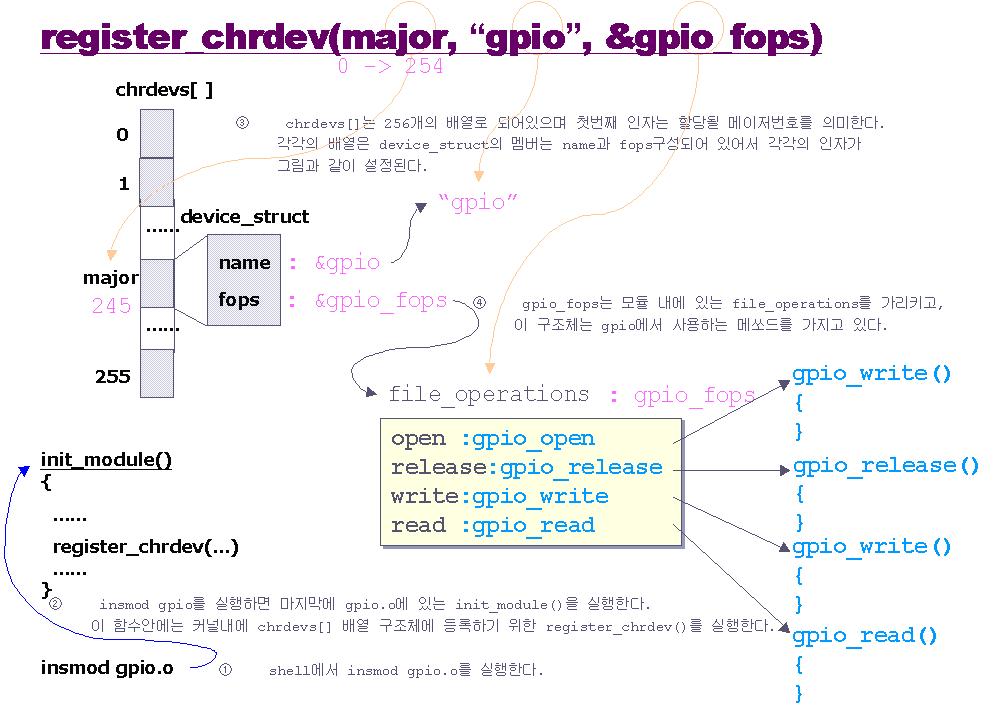
출처 : http://blog.naver.com/kingseft?Redirect=Log&logNo=140004281000
module.h 에는 임베디드 프로그램을 만드는데 유용한 매크로들이 포함되어 있다.
여기에 그 내용을 싣는다.(커널 버전은 2.4.19)
/*
* Dynamic loading of modules into the kernel.
*
* Rewritten by Richard Henderson <rth@tamu.edu> Dec 1996
*/
#ifndef _LINUX_MODULE_H
#define _LINUX_MODULE_H
#include <linux/config.h>
#include <linux/spinlock.h>
#include <linux/list.h>
#ifdef __GENKSYMS__
# define _set_ver(sym) sym
# undef MODVERSIONS
# define MODVERSIONS
#else /* ! __GENKSYMS__ */
# if !defined(MODVERSIONS) && defined(EXPORT_SYMTAB)
# define _set_ver(sym) sym
# include <linux/modversions.h>
# endif
#endif /* __GENKSYMS__ */
#include <asm/atomic.h>
/* Don’t need to bring in all of uaccess.h just for this decl. */
struct exception_table_entry;
/* Used by get_kernel_syms, which is obsolete. */
struct kernel_sym
{
unsigned long value;
char name[60]; /* should have been 64-sizeof(long); oh well */
};
struct module_symbol
{
unsigned long value;
const char *name;
};
struct module_ref
{
struct module *dep; /* “parent” pointer */
struct module *ref; /* “child” pointer */
struct module_ref *next_ref;
};
/* TBD */
struct module_persist;
struct module
{
unsigned long size_of_struct; /* == sizeof(module) */
struct module *next;
const char *name;
unsigned long size;
union
{
atomic_t usecount;
long pad;
} uc; /* Needs to keep its size – so says rth */
unsigned long flags; /* AUTOCLEAN et al */
unsigned nsyms;
unsigned ndeps;
struct module_symbol *syms;
struct module_ref *deps;
struct module_ref *refs;
int (*init)(void);
void (*cleanup)(void);
const struct exception_table_entry *ex_table_start;
const struct exception_table_entry *ex_table_end;
#ifdef __alpha__
unsigned long gp;
#endif
/* Members past this point are extensions to the basic
module support and are optional. Use mod_member_present()
to examine them. */
const struct module_persist *persist_start;
const struct module_persist *persist_end;
int (*can_unload)(void);
int runsize; /* In modutils, not currently used */
const char *kallsyms_start; /* All symbols for kernel debugging */
const char *kallsyms_end;
const char *archdata_start; /* arch specific data for module */
const char *archdata_end;
const char *kernel_data; /* Reserved for kernel internal use */
};
struct module_info
{
unsigned long addr;
unsigned long size;
unsigned long flags;
long usecount;
};
/* Bits of module.flags. */
#define MOD_UNINITIALIZED 0
#define MOD_RUNNING 1
#define MOD_DELETED 2
#define MOD_AUTOCLEAN 4
#define MOD_VISITED 8
#define MOD_USED_ONCE 16
#define MOD_JUST_FREED 32
#define MOD_INITIALIZING 64
/* Values for query_module’s which. */
#define QM_MODULES 1
#define QM_DEPS 2
#define QM_REFS 3
#define QM_SYMBOLS 4
#define QM_INFO 5
/* Can the module be queried? */
#define MOD_CAN_QUERY(mod) (((mod)->flags & (MOD_RUNNING | MOD_INITIALIZING)) && !((mod)->flags & MOD_DELETED))
/* When struct module is extended, we must test whether the new member
is present in the header received from insmod before we can use it.
This function returns true if the member is present. */
#define mod_member_present(mod,member)
((unsigned long)(&((struct module *)0L)->member + 1)
<= (mod)->size_of_struct)
/*
* Ditto for archdata. Assumes mod->archdata_start and mod->archdata_end
* are validated elsewhere.
*/
#define mod_archdata_member_present(mod, type, member)
(((unsigned long)(&((type *)0L)->member) +
sizeof(((type *)0L)->member)) <=
((mod)->archdata_end – (mod)->archdata_start))
/* Check if an address p with number of entries n is within the body of module m */
#define mod_bound(p, n, m) ((unsigned long)(p) >= ((unsigned long)(m) + ((m)->size_of_struct)) &&
(unsigned long)((p)+(n)) <= (unsigned long)(m) + (m)->size)
/* Backwards compatibility definition. */
#define GET_USE_COUNT(module) (atomic_read(&(module)->uc.usecount))
/* Poke the use count of a module. */
#define __MOD_INC_USE_COUNT(mod)
(atomic_inc(&(mod)->uc.usecount), (mod)->flags |= MOD_VISITED|MOD_USED_ONCE)
#define __MOD_DEC_USE_COUNT(mod)
(atomic_dec(&(mod)->uc.usecount), (mod)->flags |= MOD_VISITED)
#define __MOD_IN_USE(mod)
(mod_member_present((mod), can_unload) && (mod)->can_unload
? (mod)->can_unload() : atomic_read(&(mod)->uc.usecount))
/* Indirect stringification. */
#define __MODULE_STRING_1(x) #x
#define __MODULE_STRING(x) __MODULE_STRING_1(x)
/* Generic inter module communication.
*
* NOTE: This interface is intended for small amounts of data that are
* passed between two objects and either or both of the objects
* might be compiled as modules. Do not over use this interface.
*
* If more than two objects need to communicate then you probably
* need a specific interface instead of abusing this generic
* interface. If both objects are *always* built into the kernel
* then a global extern variable is good enough, you do not need
* this interface.
*
* Keith Owens <kaos@ocs.com.au> 28 Oct 2000.
*/
#ifdef __KERNEL__
#define HAVE_INTER_MODULE
extern void inter_module_register(const char *, struct module *, const void *);
extern void inter_module_unregister(const char *);
extern const void *inter_module_get(const char *);
extern const void *inter_module_get_request(const char *, const char *);
extern void inter_module_put(const char *);
struct inter_module_entry {
struct list_head list;
const char *im_name;
struct module *owner;
const void *userdata;
};
extern int try_inc_mod_count(struct module *mod);
#endif /* __KERNEL__ */
#if defined(MODULE) && !defined(__GENKSYMS__)
/* Embedded module documentation macros. */
/* For documentation purposes only. */
#define MODULE_AUTHOR(name)
const char __module_author[] __attribute__((section(“.modinfo”))) =
“author=” name
#define MODULE_DESCRIPTION(desc)
const char __module_description[] __attribute__((section(“.modinfo”))) =
“description=” desc
/* Could potentially be used by kmod… */
#define MODULE_SUPPORTED_DEVICE(dev)
const char __module_device[] __attribute__((section(“.modinfo”))) =
“device=” dev
/* Used to verify parameters given to the module. The TYPE arg should
be a string in the following format:
[min[-max]]{b,h,i,l,s}
The MIN and MAX specifiers delimit the length of the array. If MAX
is omitted, it defaults to MIN; if both are omitted, the default is 1.
The final character is a type specifier:
b byte
h short
i int
l long
s string
*/
#define MODULE_PARM(var,type)
const char __module_parm_##var[]
__attribute__((section(“.modinfo”))) =
“parm_” __MODULE_STRING(var) “=” type
#define MODULE_PARM_DESC(var,desc)
const char __module_parm_desc_##var[]
__attribute__((section(“.modinfo”))) =
“parm_desc_” __MODULE_STRING(var) “=” desc
/*
* MODULE_DEVICE_TABLE exports information about devices
* currently supported by this module. A device type, such as PCI,
* is a C-like identifier passed as the first arg to this macro.
* The second macro arg is the variable containing the device
* information being made public.
*
* The following is a list of known device types (arg 1),
* and the C types which are to be passed as arg 2.
* pci – struct pci_device_id – List of PCI ids supported by this module
* isapnp – struct isapnp_device_id – List of ISA PnP ids supported by this module
* usb – struct usb_device_id – List of USB ids supported by this module
*/
#define MODULE_GENERIC_TABLE(gtype,name)
static const unsigned long __module_##gtype##_size
__attribute__ ((unused)) = sizeof(struct gtype##_id);
static const struct gtype##_id * __module_##gtype##_table
__attribute__ ((unused)) = name
/*
* The following license idents are currently accepted as indicating free
* software modules
*
* “GPL” [GNU Public License v2 or later]
* “GPL v2” [GNU Public License v2]
* “GPL and additional rights” [GNU Public License v2 rights and more]
* “Dual BSD/GPL” [GNU Public License v2 or BSD license choice]
* “Dual MPL/GPL” [GNU Public License v2 or Mozilla license choice]
*
* The following other idents are available
*
* “Proprietary” [Non free products]
*
* There are dual licensed components, but when running with Linux it is the
* GPL that is relevant so this is a non issue. Similarly LGPL linked with GPL
* is a GPL combined work.
*
* This exists for several reasons
* 1. So modinfo can show license info for users wanting to vet their setup
* is free
* 2. So the community can ignore bug reports including proprietary modules
* 3. So vendors can do likewise based on their own policies
*/
#define MODULE_LICENSE(license)
static const char __module_license[] __attribute__((section(“.modinfo”))) =
“license=” license
/* Define the module variable, and usage macros. */
extern struct module __this_module;
#define THIS_MODULE (&__this_module)
#define MOD_INC_USE_COUNT __MOD_INC_USE_COUNT(THIS_MODULE)
#define MOD_DEC_USE_COUNT __MOD_DEC_USE_COUNT(THIS_MODULE)
#define MOD_IN_USE __MOD_IN_USE(THIS_MODULE)
#include <linux/version.h>
static const char __module_kernel_version[] __attribute__((section(“.modinfo”))) =
“kernel_version=” UTS_RELEASE;
#ifdef MODVERSIONS
static const char __module_using_checksums[] __attribute__((section(“.modinfo”))) =
“using_checksums=1”;
#endif
#else /* MODULE */
#define MODULE_AUTHOR(name)
#define MODULE_LICENSE(license)
#define MODULE_DESCRIPTION(desc)
#define MODULE_SUPPORTED_DEVICE(name)
#define MODULE_PARM(var,type)
#define MODULE_PARM_DESC(var,desc)
/* Create a dummy reference to the table to suppress gcc unused warnings. Put
* the reference in the .data.exit section which is discarded when code is built
* in, so the reference does not bloat the running kernel. Note: cannot be
* const, other exit data may be writable.
*/
#define MODULE_GENERIC_TABLE(gtype,name)
static const struct gtype##_id * __module_##gtype##_table
__attribute__ ((unused, __section__(“.data.exit”))) = name
#ifndef __GENKSYMS__
#define THIS_MODULE NULL
#define MOD_INC_USE_COUNT do { } while (0)
#define MOD_DEC_USE_COUNT do { } while (0)
#define MOD_IN_USE 1
extern struct module *module_list;
#endif /* !__GENKSYMS__ */
#endif /* MODULE */
#define MODULE_DEVICE_TABLE(type,name)
MODULE_GENERIC_TABLE(type##_device,name)
/* Export a symbol either from the kernel or a module.
In the kernel, the symbol is added to the kernel’s global symbol table.
In a module, it controls which variables are exported. If no
variables are explicitly exported, the action is controled by the
insmod -[xX] flags. Otherwise, only the variables listed are exported.
This obviates the need for the old register_symtab() function. */
#if defined(__GENKSYMS__)
/* We want the EXPORT_SYMBOL tag left intact for recognition. */
#elif !defined(AUTOCONF_INCLUDED)
#define __EXPORT_SYMBOL(sym,str) error config_must_be_included_before_module
#define EXPORT_SYMBOL(var) error config_must_be_included_before_module
#define EXPORT_SYMBOL_NOVERS(var) error config_must_be_included_before_module
#define EXPORT_SYMBOL_GPL(var) error config_must_be_included_before_module
#elif !defined(CONFIG_MODULES)
#define __EXPORT_SYMBOL(sym,str)
#define EXPORT_SYMBOL(var)
#define EXPORT_SYMBOL_NOVERS(var)
#define EXPORT_SYMBOL_GPL(var)
#elif !defined(EXPORT_SYMTAB)
#define __EXPORT_SYMBOL(sym,str) error this_object_must_be_defined_as_export_objs_in_the_Makefile
#define EXPORT_SYMBOL(var) error this_object_must_be_defined_as_export_objs_in_the_Makefile
#define EXPORT_SYMBOL_NOVERS(var) error this_object_must_be_defined_as_export_objs_in_the_Makefile
#define EXPORT_SYMBOL_GPL(var) error this_object_must_be_defined_as_export_objs_in_the_Makefile
#else
#define __EXPORT_SYMBOL(sym, str)
const char __kstrtab_##sym[]
__attribute__((section(“.kstrtab”))) = str;
const struct module_symbol __ksymtab_##sym
__attribute__((section(“__ksymtab”))) =
{ (unsigned long)&sym, __kstrtab_##sym }
#define __EXPORT_SYMBOL_GPL(sym, str)
const char __kstrtab_##sym[]
__attribute__((section(“.kstrtab”))) = “GPLONLY_” str;
const struct module_symbol __ksymtab_##sym
__attribute__((section(“__ksymtab”))) =
{ (unsigned long)&sym, __kstrtab_##sym }
#if defined(MODVERSIONS) || !defined(CONFIG_MODVERSIONS)
#define EXPORT_SYMBOL(var) __EXPORT_SYMBOL(var, __MODULE_STRING(var))
#define EXPORT_SYMBOL_GPL(var) __EXPORT_SYMBOL_GPL(var, __MODULE_STRING(var))
#else
#define EXPORT_SYMBOL(var) __EXPORT_SYMBOL(var, __MODULE_STRING(__VERSIONED_SYMBOL(var)))
#define EXPORT_SYMBOL_GPL(var) __EXPORT_SYMBOL(var, __MODULE_STRING(__VERSIONED_SYMBOL(var)))
#endif
#define EXPORT_SYMBOL_NOVERS(var) __EXPORT_SYMBOL(var, __MODULE_STRING(var))
#endif /* __GENKSYMS__ */
#ifdef MODULE
/* Force a module to export no symbols. */
#define EXPORT_NO_SYMBOLS __asm__(“.section __ksymtabn.previous”)
#else
#define EXPORT_NO_SYMBOLS
#endif /* MODULE */
#ifdef CONFIG_MODULES
#define SET_MODULE_OWNER(some_struct) do { (some_struct)->owner = THIS_MODULE; } while (0)
#else
#define SET_MODULE_OWNER(some_struct) do { } while (0)
#endif
#endif /* _LINUX_MODULE_H */
errno.h 파일에는 여러가지 에러코드에 대한 정의가 수록되어 있다.
여기에 그 내용을 싣는다.
#ifndef _ASM_GENERIC_ERRNO_H
#define _ASM_GENERIC_ERRNO_H
#include <asm-generic/errno-base.h>
#define EDEADLK 35 /* Resource deadlock would occur */
#define ENAMETOOLONG 36 /* File name too long */
#define ENOLCK 37 /* No record locks available */
#define ENOSYS 38 /* Function not implemented */
#define ENOTEMPTY 39 /* Directory not empty */
#define ELOOP 40 /* Too many symbolic links encountered */
#define EWOULDBLOCK EAGAIN /* Operation would block */
#define ENOMSG 42 /* No message of desired type */
#define EIDRM 43 /* Identifier removed */
#define ECHRNG 44 /* Channel number out of range */
#define EL2NSYNC 45 /* Level 2 not synchronized */
#define EL3HLT 46 /* Level 3 halted */
#define EL3RST 47 /* Level 3 reset */
#define ELNRNG 48 /* Link number out of range */
#define EUNATCH 49 /* Protocol driver not attached */
#define ENOCSI 50 /* No CSI structure available */
#define EL2HLT 51 /* Level 2 halted */
#define EBADE 52 /* Invalid exchange */
#define EBADR 53 /* Invalid request descriptor */
#define EXFULL 54 /* Exchange full */
#define ENOANO 55 /* No anode */
#define EBADRQC 56 /* Invalid request code */
#define EBADSLT 57 /* Invalid slot */
#define EDEADLOCK EDEADLK
#define EBFONT 59 /* Bad font file format */
#define ENOSTR 60 /* Device not a stream */
#define ENODATA 61 /* No data available */
#define ETIME 62 /* Timer expired */
#define ENOSR 63 /* Out of streams resources */
#define ENONET 64 /* Machine is not on the network */
#define ENOPKG 65 /* Package not installed */
#define EREMOTE 66 /* Object is remote */
#define ENOLINK 67 /* Link has been severed */
#define EADV 68 /* Advertise error */
#define ESRMNT 69 /* Srmount error */
#define ECOMM 70 /* Communication error on send */
#define EPROTO 71 /* Protocol error */
#define EMULTIHOP 72 /* Multihop attempted */
#define EDOTDOT 73 /* RFS specific error */
#define EBADMSG 74 /* Not a data message */
#define EOVERFLOW 75 /* Value too large for defined data type */
#define ENOTUNIQ 76 /* Name not unique on network */
#define EBADFD 77 /* File descriptor in bad state */
#define EREMCHG 78 /* Remote address changed */
#define ELIBACC 79 /* Can not access a needed shared library */
#define ELIBBAD 80 /* Accessing a corrupted shared library */
#define ELIBSCN 81 /* .lib section in a.out corrupted */
#define ELIBMAX 82 /* Attempting to link in too many shared libraries */
#define ELIBEXEC 83 /* Cannot exec a shared library directly */
#define EILSEQ 84 /* Illegal byte sequence */
#define ERESTART 85 /* Interrupted system call should be restarted */
#define ESTRPIPE 86 /* Streams pipe error */
#define EUSERS 87 /* Too many users */
#define ENOTSOCK 88 /* Socket operation on non-socket */
#define EDESTADDRREQ 89 /* Destination address required */
#define EMSGSIZE 90 /* Message too long */
#define EPROTOTYPE 91 /* Protocol wrong type for socket */
#define ENOPROTOOPT 92 /* Protocol not available */
#define EPROTONOSUPPORT 93 /* Protocol not supported */
#define ESOCKTNOSUPPORT 94 /* Socket type not supported */
#define EOPNOTSUPP 95 /* Operation not supported on transport endpoint */
#define EPFNOSUPPORT 96 /* Protocol family not supported */
#define EAFNOSUPPORT 97 /* Address family not supported by protocol */
#define EADDRINUSE 98 /* Address already in use */
#define EADDRNOTAVAIL 99 /* Cannot assign requested address */
#define ENETDOWN 100 /* Network is down */
#define ENETUNREACH 101 /* Network is unreachable */
#define ENETRESET 102 /* Network dropped connection because of reset */
#define ECONNABORTED 103 /* Software caused connection abort */
#define ECONNRESET 104 /* Connection reset by peer */
#define ENOBUFS 105 /* No buffer space available */
#define EISCONN 106 /* Transport endpoint is already connected */
#define ENOTCONN 107 /* Transport endpoint is not connected */
#define ESHUTDOWN 108 /* Cannot send after transport endpoint shutdown */
#define ETOOMANYREFS 109 /* Too many references: cannot splice */
#define ETIMEDOUT 110 /* Connection timed out */
#define ECONNREFUSED 111 /* Connection refused */
#define EHOSTDOWN 112 /* Host is down */
#define EHOSTUNREACH 113 /* No route to host */
#define EALREADY 114 /* Operation already in progress */
#define EINPROGRESS 115 /* Operation now in progress */
#define ESTALE 116 /* Stale NFS file handle */
#define EUCLEAN 117 /* Structure needs cleaning */
#define ENOTNAM 118 /* Not a XENIX named type file */
#define ENAVAIL 119 /* No XENIX semaphores available */
#define EISNAM 120 /* Is a named type file */
#define EREMOTEIO 121 /* Remote I/O error */
#define EDQUOT 122 /* Quota exceeded */
#define ENOMEDIUM 123 /* No medium found */
#define EMEDIUMTYPE 124 /* Wrong medium type */
#define ECANCELED 125 /* Operation Canceled */
#define ENOKEY 126 /* Required key not available */
#define EKEYEXPIRED 127 /* Key has expired */
#define EKEYREVOKED 128 /* Key has been revoked */
#define EKEYREJECTED 129 /* Key was rejected by service */
/* for robust mutexes */
#define EOWNERDEAD 130 /* Owner died */
#define ENOTRECOVERABLE 131 /* State not recoverable */
#endif
#define EPERM 1 /* Operation not permitted */
#define ENOENT 2 /* No such file or directory */
#define ESRCH 3 /* No such process */
#define EINTR 4 /* Interrupted system call */
#define EIO 5 /* I/O error */
#define ENXIO 6 /* No such device or address */
#define E2BIG 7 /* Argument list too long */
#define ENOEXEC 8 /* Exec format error */
#define EBADF 9 /* Bad file number */
#define ECHILD 10 /* No child processes */
#define EAGAIN 11 /* Try again */
#define ENOMEM 12 /* Out of memory */
#define EACCES 13 /* Permission denied */
#define EFAULT 14 /* Bad address */
#define ENOTBLK 15 /* Block device required */
#define EBUSY 16 /* Device or resource busy */
#define EEXIST 17 /* File exists */
#define EXDEV 18 /* Cross-device link */
#define ENODEV 19 /* No such device */
#define ENOTDIR 20 /* Not a directory */
#define EISDIR 21 /* Is a directory */
#define EINVAL 22 /* Invalid argument */
#define ENFILE 23 /* File table overflow */
#define EMFILE 24 /* Too many open files */
#define ENOTTY 25 /* Not a typewriter */
#define ETXTBSY 26 /* Text file busy */
#define EFBIG 27 /* File too large */
#define ENOSPC 28 /* No space left on device */
#define ESPIPE 29 /* Illegal seek */
#define EROFS 30 /* Read-only file system */
#define EMLINK 31 /* Too many links */
#define EPIPE 32 /* Broken pipe */
#define EDOM 33 /* Math argument out of domain of func */
#define ERANGE 34 /* Math result not representable */
#endif
다음과 같은 명령을 이용하여 디바이스 드라이버를 커널에 삽입한다.
$ insmod driver.o
여기서 driver.o는 테스트로 작성된 디바이스 드라이버 파일명이다.
위와 같이 콘솔에서 insmod driver.o 를 실행 시키면 다음과 같은 시스템 콜이 수행되어 드라이버를 커널에 삽입한다.
1. sys_create_module()을 사용하여 디바이스 드라이버를 적재하기 위한 메모리를 할당한다.
2. sys_get_kernel_syms()를 이용하여 driver.o 안에 있는 심볼을 커널에 등록한다.
3. 마지막으로 sys_init_module() 을 사용하여 driver.o를 메모리에 적재한다. 이 과정에서 driver.o 안에 있는 init_module()이 실행되고 그 안에 있는 커널 함수인 register_chrdev() 가 수행되어 디바이스 드라이버 이름과 메이저 번호와 file_operations 구조체를 커널 변수인 chrdevs에 등록한다.
위와 같이 디바이스 드라이버를 커널에 삽입했으면 다음 해야 하는 일은 드라이버에 대응하는 특수 장치 파일(노드)을 만드는 일이다.
다음은 콘솔에서 특수 장치 파일을 만드는 명령이다.
$ mknod /dev/device c 주번호 부번호
위의 명령에 의해 커널에서 수행 되는 일은 다음과 같다. mknod 명령은 커널의 sys_mknod()를 호출하고 이 함수는 다음과 같은 일을 수행한다.
1. 먼저 /(root) 에서 시작해서 dev 디렉토리까지의 경로를 찾아 새로운 dentry를 하나 만들고 루트에 연결한다.
2. inode 하나를 만들고 dentry의 d_inode에 연결한다.
3. inode의 i_mode 와 i_rdev에 S_IFCHR 과 (주번호 << 8 | 부번호)을 기록한다.
4. inode의 i_fop에 def_chr_fops의 주소값을 기록하여 이를 통해 open 메소드에 chrdev_open()이 연결되도록 한다.
위와 같이 커널에 디바이스 드라이버를 삽입하고 이것에 대응하는 특수장치 파일을 만들어야 어플리케이션의 디바이스 드라이버 사용이 가능하다.
struct file_operations {
struct module *owner;
// llseek 메소드는 파일에서 현재의 read/write의 위치를 옮기며, 새로운 위치가 (양수)값으로 리턴된다. 에러는 음수값으로 반환된다.
loff_ (*llseek) (struct file *, loff_t, int);
// read 메소드는 디바이스에서 데이터를 가져오기 위해서 사용한다. 여기에 NULL 값을 사용하면 read 시스템
콜은 -EINVAL(“잘못된 매개 변수”)값을 돌려 주며 실패한다. 음수값이 아닌 리턴값은 성공적으로 읽은 바이트 수를 나타낸다.
ssize_t (*read) (struct file *, char *, size_t, loff_t *);
// 디바이스에 데이터를 보낸다. NULL 값을 스면 wirte 시스템 콜에 대해서 -EINVAL을 돌려준다. 리턴값이 음수가 아니면 성공적으로 작성된 데이터의 바이트 크기이다.
ssize_t (*write) (struct file *, const char *, size_t, loff_t *);
// 이 함수 포인터는 디바이스 노드에 대해서는 NULL이어야 한다. 이것은 디렉토리에 대해서 사용한다.
int (*readdir) (struct file *, void *, filldir_t);
// 현재의 프로세스를 대기 큐에 넣는다.
unsigned int (*poll) (struct file *, struct poll_table_strcut *);
// ioctl 시스템 콜은 디바이스에 종속적인 명령을 만들 수 있도록한다. 커널이 fops 테이블을 참조하지 않고도 인식할 수 있는 많은 ioctl 명령이 있다.
int (*ioctl) (struct inode *, struct file *, unsigned int, unsigned long);
// mmap은 디바이스 메모리를 프로세서의 메모리에 맵핑시키도록 요청하기 위해 사용된다. 디바이스가 이 방법을 제공하지 않으면 리턴값은 ENODEV 이다.
int (*mmap) (struct file *, struct vm_area_struct *);
// 이 항목이 NULL 로 되어 있으면 디바이스 open 호출은 언제나 성공적이다.
int (*open) (struct inode *, struct file *);
// 연린 디바이스를 닫기 이전에 모든 데이터를 쓰도록 하기 위해서 사용한다.
int (*flush) (struct file *);
// 노드를 닫을 때 수행된다.
int (*release) (struct inode *, struct file *);
// 데이터 중에서 버퍼에 있는 것은 모두 디바이스에 쓴다. 이 메소드가 지원되지 않으면 fsync 시스템 콜은 -EINVAL 리턴값을 갖는다.
int (*fsync) (struct file *, struct dentry *, int datasync);
// 이 동작은 FASYNC 플래그에 변화가 있는 디바이스를 확인하기 위해서 사용한다. 드라이버가 비동기 통지를 지원하지 않을 경우에 이 필드를 NULL로 두면 된다.
int (*fasync) (int, struct file *, int);
// 파일에 락을 걸기 위해서 사용한다.
int (*lock) (struct file *, int, struct file_lock *);
ssize_t (*readv) (struct file *, const struct iovec *, unsigned long, loff_t *);
ssize_t (*writev) (struct file *, const struct iovec *, unsigned long, loff_t *);
ssize_t (*sendpage) (struct file *, struct page *, int, size_t, loff_t *, int);
unsigned long (*get_unmapped_area) (struct file *, unsigned long,
unsigned long, unsigned long, unsigned long, unsigned long);
}
참조 : http://blog.naver.com/sglinux2418?Redirect=Log&logNo=20185596